
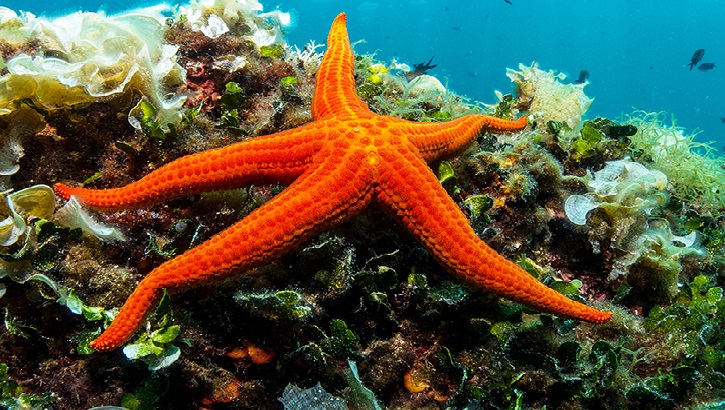
A recently published report highlights that coral bleaching is being made worse by global warming. But, according to Australian scientists, it might also promote the growth of crown-of-thorns starfish, a type of predatory starfish extremely resilient to marine heat waves and feeding on coral reefs.
The crown-of-thorns starfish (Acanthaster) is frequently referred to as the worst enemy of corals. These starfish are herbivores when they are young. But as they grow older, they become carnivores that eat coral reefs. According to marine biologists from Australia’s University of Sydney, juveniles “have potential for long-term persistence as herbivores as they wait for live coral to recover before becoming coral predators.” They used heat stress scenarios intended to simulate the impact of marine heatwaves, replicating the circumstances that lead to coral bleaching and mortality, to assess the resilience of young crown-of-thorns starfish.
Also read: Global Warming threat by livestock and its control
Two aluminum blocks set parallel to each other and with hot and cold water inlets at each end were used to create these circumstances for the starfish trials. The temperatures of 28°C, 29°C, and 30°C were tested in three different heat wave scenarios. The reference temperature was 27°C, the maximum mean summer sea surface temperature to which Acanthaster sea stars are exposed in the southern Great Barrier Reef. The optimum temperature for coral bleaching in the same area is 28.3°C. The study found that coral was not as resilient to hot conditions as starfish.
According to study findings reported in the journal Global Change Biology, young crown-of-thorns starfish survived 20 days of high temperatures. “We found juvenile crown-of-thorns starfish can tolerate almost three times the heat intensity that causes coral bleaching, using a model that measures temperature over time.” This is an important finding that has implications for understanding the impacts of climate change on marine ecosystems.