
Teacher training: Encourage students to engage in reflective learning through reflective practice

Reflective Practice

Reflective practice is associated with experience-based learning. Professionals successfully employ reflective practice, a crucial lifetime learning tactic. Professionals who are qualified, independent, and self-directed can be developed through reflective practice. Reflective practice fosters both professional and personal growth and closes the gap between theory and practice.

Key Elements of Reflection

Reflection has following key

  • Making sense of experience
  • ‘Standing back’ to gain a better perspective of the experience.
  • Repetition and checking for missing things
  • Deeper honesty to accept the normal course of events
  • ‘Weighing up’ and balanced in judgement
  • Clarity as viewing the events being reflected by a mirror
  • Deeper understanding

Making judgments to develop or adopt a strategy, activity or an approach.

Models of Reflection

A number of models of reflection have been put out to help individuals engage in the process of reflection. It is up to the individual to choose a model or framework for reflection that suits him and allows him to draw lessons from his prior learning experiences. Below is a discussion of some of the significant models of reflection.

Gibbs Reflective Cycle

Gibbs (1988) introduced a fairly simple reflective cycle that promotes a clear description of the situation, analysis of feelings, evaluation of the experience, analysis to make sense of the experience, conclusion where other options are considered, and reflection upon experience to examine what you would do if the situation arose again.

ALSO READ: The comparison of teacher education program objectives between developed and developing countries

Johns (2000) Model for Structured Reflection

A critical event analysis or a general reflection on experience can be guided by John’s structured reflection approach. For more intricate analysis and decision-making, this might be helpful.

Rolfe et al (2001) Framework for Reflexive Practice

The questions such as “What? What so? And now, what can encourage introspection at all levels? For level 1 reflection, the model can be used merely at the descriptive level. The framework’s sequential and cyclical sequence is indicated by the arrows at the top of the diagram. To describe the circumstance, the practitioner first considers it. In order to learn from the circumstance, the second phase encourages the practitioner to develop personal theory and expertise. At the third level, the practitioner evaluates his or her activities, thinks about methods to make things better, and considers the effects of those acts. According to Rolfe et al., this last phase has the potential to have the biggest impact on practice.

Reflective Thinking in Teaching

In essence, reflection is the critical thinking and analysis of our own and our students’ experiences and behaviors with the goal of enhancing professional practices. It makes it possible to modify general teaching and learning guidelines to fit our specific situation and enhance instruction. To become a scholar teacher, one must be a “reflective practitioner.” The pedagogical strategy to encourage independent learning with the goal of enhancing students’ critical thinking, comprehension, and abilities is a prerequisite for instructors’ reflective practice. Put another way, reflective practice in teaching is the process of critically analyzing one’s own methods of instruction in the classroom and identifying the most effective approaches to employ for the students. Theoretical and tacit knowledge are continuously integrated.

Enabling Reflective Thinking in Learning

Learning requires reflection, which must be combined with action. Constructivists see education as the process of creating knowledge and understandings of the world via inquiry, analysis, and interpretation. Thus, reflection serves as a bridge between assimilating new information and incorporating it with preexisting knowledge of the environment. The value of reflection in education is found in its capacity to provide students new perspectives, make sense of their ideas, and enhance their comprehension of the world.

ALSO READ: Fully Funded CSC Scholarships at Zhejiang Normal University in China, 2026

Following steps can be taken to enable students for reflective learning

For helping the students to learn to reflect

The First Stage is Presenting Reflection

  • Explain how reflection is different from other familiar forms of learning
  • Give examples of reflective writing – good and poor
  • Generate discussion of students’ conceptions of reflection
  • Enable practice on reflective writing and provide opportunities for feedback
  • Give a starting exercise
  • Expect to support some students more than others
  • Be open about your need to learn about this form of learning and how to manage it
  • The Second Stage is Deepening Reflective Work
  • Use examples to demonstrate deeper reflective activity
  • Introduce a framework that describes levels of reflection
  • Introduce exercises that involve ‘standing back from oneself’.
  • Introduce exercises that involve reflection on the same subject from different viewpoints of people / social institutions etc.
  • Introduce an exercise in reflection on the same subject from viewpoints of different disciplines
  • Introduce an exercise that involves reflection that is influenced by emotional reactions to events
  • Collaborative methods of deepening reflection–e.g. critical friends and group, activities etc.

Ways of Reflection

There are two ways of reflection which include formal and informal reflection.

  1. Informal Reflection
  2. Formal Reflection

Formal reflection is based on the findings of theory and research

Modes of Reflective Practice

Researchers have identified three modes of reflective practice.

Reflection in Practice

This entails reflecting on the teacher’s actions and behaviors during the classroom teaching process. Teachers can think independently and solve issues that arise in their daily teaching by engaging in this kind of contemplation.

Reflection on Practice

It refers to the teacher’s reflections following his instruction in the classroom with an emphasis on transpiration and elements of the classroom experience that either helped or impeded learning during interactions with the pupils.

Reflection for Practice

It is the teacher’s way of thinking about how past practice will help future experiences. The instructor makes decisions in the future based on his understanding of his prior experiences. Teachers can develop new understandings of theories in a variety of contextual contexts through reflection in practice.

Possible Benefits of Reflective Practice Used by Teacher

Reflection can be helpful for us as teachers because it

  • Allows us to consciously develop our own repertoire of strategies and techniques to draw upon in our teaching, which are relevant to our particular context and discipline.
  • Helps us take informed actions that can be justified and explained to others and that we can use to generate answers to teaching problems.
  • Allows us to adjust and respond to issues and problems. For instance, rather than being devastated by a poor teaching evaluation, it allows us to investigate and understand.
  • helps us to become aware of our underlying beliefs and assumptions about learning and teaching so we understand why we do what we do and what might need to change.
  • Helps to become conscious of our potential for bias & discrimination.
  • Enables us to make the best use of the knowledge available.
  • Enables to avoid past mistakes
  • Helps to maximize our own opportunities for learning.
  • Provides guidance & frameworks for practice
  • We can acknowledge immediate feelings, and then stand back from them
  • Reflection helps us to see what went well and focus on the positive side of an event as well as the more negative
  • Helps us to develop a problem-solving approach, rather than avoiding thinking about difficulties
  • Helps us to locate our teaching in the broader institutional, social, and political context and to appreciate the many factors that influence student learning. In this way,
  • Reflection helps us to keep our perspectives and to avoid blaming ourselves for every problem that arises in our classrooms.

Measures to Integrate Reflective Practice in Teacher Education
Curriculum

A combination of theoretical and tacit knowledge forms the foundation of efficient professional preparation, such as teacher preparation. As a result, practitioners anticipate that student teachers’ classroom experiences will be applicable to actual classroom scenarios. Professional preparation programs, clinical experiences, and internships should be created with three goals in mind. The first goal is to help student teachers acquire theoretical knowledge that will enable them to describe, explain, and anticipate behavior that affects effective teaching. Second, student teachers will become proficient in the process of reflection and acquire the ability to evaluate their actions and results in light of current professional knowledge. Lastly, by examining their choices in light of contextual factors in the classroom, student instructors will use reflection to bridge theory and experience. Giving teachers the tools they need to solve practical issues that defy textbook solutions is the ultimate goal in achieving these goals.

ALSO READ: Latest Stories & Science News
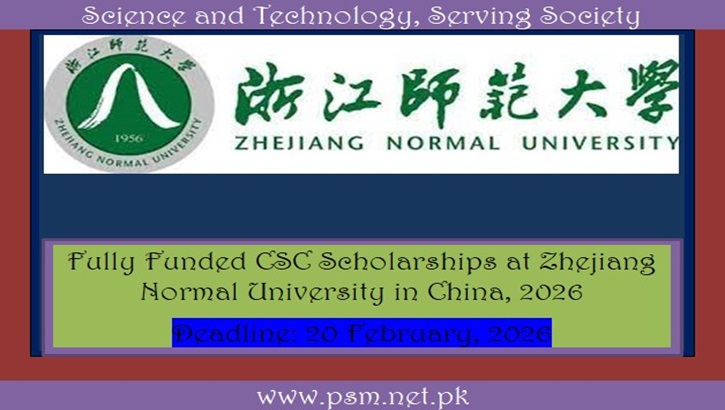
Fully Funded CSC Scholarships at Zhejiang Normal University in China, 2026

Are you dreaming of pursuing your higher education in China with a fully funded scholarship? The Zhejiang Normal University CSC Scholarship 2026 could be your chance to realize your desire if you apply for fully funded scholarships here! This scholarship provides overseas students with fully paid assistance to study master’s and doctoral degrees at Zhejiang Normal University, a prestigious university in Jinhua, China.

Zhejiang Normal University CSC Scholarship Details

The Zhejiang Normal University CSC Scholarship is a part of the China Scholarship Council (CSC) program in China. It offers overseas students enrolled in the university’s master’s and doctoral programs complete financial support. This indicates that all significant costs are covered by the scholarship, such as:

  • Tuition fees
  • Accommodation
  • Living allowance
  • Travel expenses
  • Health insurance
University:Zhejiang Normal University
Degree level:Masters, PhD
Scholarship coverage:Fully Funded
Eligible nationality:All Nationalities
Award country:China
Last Date:20th February 2026

Degree Levels

The Zhejiang Normal University CSC Scholarship is available for the following degree levels:

  • Master’s Degree: For students wishing to pursue a master’s degree at Zhejiang Normal University.
  • PhD Degree: For students wishing to pursue a PhD degree at Zhejiang Normal University.

Eligibility Criteria

  • Nationalities: Open to all international students.
  • Academic Requirements:
    • For master’s applicants, you should have a bachelor’s degree or equivalent.
    • For PhD applicants, you should have a master’s degree or equivalent.
  • Age Limit:
    • For master’s degree applicants, you should be under 35 years of age.
    • For PhD applicants, you should be under 40 years of age.
  • Language Requirements: You should have a strong command of English. If you’re applying for a Chinese-taught programme, proficiency in Chinese may be required.
  • Health Requirements: You must be in good health as per Chinese immigration standards.

ALSO READ: Fully Funded Scholarships at University of Bern, Switzerland, 2025

Required Documents

The following documents are required to complete your application for the scholarship:

  1. Application Form: Completed CSC Scholarship application form.
  2. Passport Copy: A valid passport with at least 6 months validity.
  3. Academic Transcripts: Certified copies of your academic transcripts.
  4. Degree Certificate: Bachelor’s degree for master’s applicants or master’s degree for PhD applicants.
  5. Recommendation Letters: Two academic recommendation letters from professors or academic advisors.
  6. Language Proficiency Certificate: Proof of English proficiency (TOEFL, IELTS, or other equivalent certificates) or Chinese language proficiency if required.
  7. Research Proposal/Study Plan: For PhD applicants, a research proposal is required, and for master’s applicants, a study plan should be submitted.
  8. Health Certificate: A medical examination certificate may be required.
  9. Other Documents: Any other documents that may be required by the university.

ALSO READ: Latest Stories & Science News

Apply for the Zhejiang Normal University CSC Scholarship

Don’t miss the chance to study in China! Make sure to submit your application before 20th February 2025 and follow the necessary steps to ensure your chance to secure this fully funded scholarship.

  1. Apply online at the CSC official website https://studyinchina.csc.edu.cn, upload all the required documents and then download the application form. The scholarship type is B, and the agency number is 10345.
  2. Also apply at University Online Web Portal at http://admission.zjnu.edu.cn

For more information and to apply, visit the CSC Scholarship Application Portal and follow the instructions carefully.

Fully Funded Scholarships at University of Bern, Switzerland, 2025

Read here to apply for fully funded scholarships at University of Bern, Switzerland. Do you have aspirations of studying in Switzerland? For the 2025 academic year, the University of Bern is offering a fully financed scholarship, giving overseas students a fantastic chance to study in Switzerland for their bachelor’s, master’s, or doctoral degrees. This scholarship may pay for all of your living expenses, tuition, and other costs if you complete the requirements. Let’s dig into the specifics so you can begin submitting your application!

The goal of the University of Bern Scholarship 2025 is to assist outstanding foreign students who want to continue their education in Switzerland. This scholarship is a fantastic opportunity for anyone wishing to study abroad at a famous university because it is fully funded, which means all of your academic expenses will be covered.

Scholarship Details

University:University of Bern
Degree level:Bachelors, Masters, PhD
Scholarship coverage:Fully Funded
Eligible nationality:All Nationalities
Award country:Switzerland
Last Date:1 December 2025

Types of Scholarships

The University of Bern offers this fully funded scholarship for three levels of study:

  • Bachelor’s: For students who want to pursue undergraduate studies.
  • Master’s: For students wishing to complete their master’s degree.
  • PhD: For those interested in conducting research at the doctoral level.

The University of Bern strives to offer complete financial support for the duration of your studies, regardless of the level you are applying for.

ALSO READ: Fully Funded SIIT University Graduate Scholarship 2026 in Thailand

Eligibility Criteria

You must fulfil specific requirements in order to apply for the University of Bern Scholarship 2025. This is a brief explanation:

The scholarship is open to students from all nationalities, so no matter where you’re from, you can apply.

You must be applying for a Bachelor’s, Master’s, or PhD program at the University of Bern.

Proficiency in either German or English is necessary for the majority of programs. Depending on the program you are applying for, the University of Bern will specify the language requirements.

You must meet the academic and admission criteria set by the university for your chosen program.

You must have a strong academic record and demonstrate the potential for success in your chosen field of study.

Applicants should not have received any previous scholarship funding from the University of Bern in the past.

Required Documents

The following documents must be submitted with your University of Bern Scholarship 2025 application:

Academic Transcripts: Certified copies of your previous academic records.

Language Proficiency Proof: IELTS, TOEFL, or any other accepted language tests.

CV/Resume: A current CV detailing your academic and extracurricular achievements.

Letter of Motivation: A personal statement outlining why you wish to study at the University of Bern and how the scholarship will benefit your academic journey.

Letters of Recommendation: Some programs may require letters of recommendation from your professors or academic advisors.

ALSO READ: Latest Stories & Science News
Apply Now

Visit the University of Bern’s scholarship application portal to submit your online application. Be sure to carefully follow the instructions provided on the portal.

The comparison of teacher education program objectives between developed and developing countries

The goals of teacher education programs differ in developed and developing nations because of disparities in educational priorities, resources, and circumstances. Although educating teachers to be capable and successful is a common goal, the precise goals may vary. These are some salient comparative points.

Quality of Education

Developed nations frequently place a high priority on educational quality in an effort to give students a well-rounded education that will meet the expectations of a globalised society. Modern knowledge and skills, creative teaching methods, and the capacity to encourage critical thinking, creativity, and problem-solving in their pupils are the main goals of teacher education programs. On the other hand, developing nations may place more value on fundamental reading and numeracy abilities, emphasising the development of core skills to reduce educational disparities and enhance educational access.

Technology Integration

Technology integration into teaching and learning is emphasised heavily in teacher education programs in developed countries. To improve instruction and support individualised learning experiences, teachers receive training on how to use digital materials, online platforms, and educational technology tools. Their teacher education programs may concentrate on developing fundamental digital literacy skills and leveraging inexpensive technological solutions to enhance teaching and learning because developing nations may lack the infrastructure and resources necessary for technology integration.

ALSO READ: The aims of the teacher education programs for the best educational system

Inclusive Education

Inclusive education, which addresses the varied requirements of students with disabilities, special educational needs, or from multiple cultural backgrounds, is highly valued in industrialised nations. Strategies for addressing individual learning needs, promoting inclusive classrooms, and customising teaching are all highlighted in teacher education programs. Although inclusive education may be becoming more and more important in underdeveloped nations, obstacles may arise due to a lack of infrastructure and resources. Programs for teacher education may emphasise increasing awareness, developing capacity, and offering tactics for inclusive practices in environments with limited resources.

Professional Development

Developed nations frequently place a high priority on teachers’ continual professional development in order to guarantee their effectiveness and advancement. Professional learning communities, in-service training, and access to best practices based on research are all features of teacher education programs. Resources may be limited in developing nations when it comes to offering comprehensive chances for professional development. Nonetheless, initiatives are underway to improve professional development through partnerships with global organisations, teacher mentorship programs, and the use of technology for online networking and training.

Teacher Retention and Motivation

Developed nations understand how critical it is to draw in and keep top-notch educators. The significance of teacher motivation, work happiness, and career progression prospects is emphasised in teacher education programs. Lack of teachers, poor pay, and unfavourable working circumstances can be problems for developing nations. In order to guarantee a steady and driven teaching profession, teacher education programs in developing nations frequently concentrate on enhancing teacher recruitment, offering incentives, and resolving retention concerns.

ALSO READ: Fully Funded SIIT University Graduate Scholarship 2026 in Thailand

Contextual Relevance

The goal of teacher education programs in both developed and developing nations is to meet the unique requirements and difficulties of their educational systems while also being pertinent to the local environment. More research and curriculum development funding may be available to developed nations, enabling more personalisation and conformity to national norms. Even though developing nations may have limitations when it comes to curriculum creation and resources, their goal is to provide educators the know-how to tackle issues unique to their nation, such poverty, cultural diversity, and restricted access to high-quality education.

Although the goals of teacher education programs in developed and developing nations differ, it’s crucial to remember that there is also a great deal of variation within each group. Even within nations, geographical differences, cultural settings, and particular educational regulations may all have a significant impact on educational objectives and strategies.

ALSO READ: Latest Stories & Science News

Fully Funded SIIT University Graduate Scholarship 2026 in Thailand

Applications are currently being accepted for the January 2026 intake of the SIIT University Graduate Scholarship 2026. This fully funded scholarship is available to international students who wish to enrol in the Sirindhorn International Institute of Technology’s Master’s and PhD programs. Applicants from Thailand and other countries are eligible for the scholarship. Excellent Thai Students (ETS) scholarship applicants will be Thai nationals, while Excellent Foreign Students (EFS) scholarship applicants will be foreign students. Application fees are free, and IELTS is not necessary. Here are some specifics on the SIIT Graduate Scholarship’s advantages, prerequisites, and application procedure.

SIIT University Graduate Scholarship 2026 Details

  1. Host Country: Thailand
  2. University Name: SIIT
  3. Degree Level: Master’s, PhD
  4. Benefits: Fully Funded
  5. Deadline: 30th September 2025

ALSO READ: Fully Funded Scholarship at GIST University South Korea, 2025

Scholarship Duration

The Duration of the Master’s Degree Scholarship is 2 years, and the Doctoral Degree is 3 years.

Financial Benefits

  1. Full Tuition & Educational Support
  2. Living Allowance/Month
  3. Round-trip Economy Airfare
  4. Visa & English Test Fees
  5. Health & Accident insurance
  6. Accommodation on Campus

Eligibility Criteria

The SIIT University Graduate Scholarship is open to all Nationals.

  1. Provides two strong recommendation letters.
  2. Bachelor’s degree transcript with a minimum GPA of 2.75.
  3. Master’s degree transcript with a minimum GPA of 3.50.
  4. Health and Conduct: Has good health and good conduct.
  5. Other Scholarships: Must not be a recipient of another type of scholarship.

Required Documents

  1. Statement of Purpose
  2. CV/Resume
  3. Official Transcript(s):
    • Bachelor’s (min. 2.75 GPA)
    • Master’s (min. 3.50 GPA, if applicable)
  4. ID Card/Passport
  5. Research/Publications/Certificates (if any)
  6. Recent Photo
  7. English Proficiency Certificate (if any).

Apply for the SIIT University Graduate Scholarship 2026

To apply for the SIIT Graduate scholarship, please follow the steps.

  1. Visit: https://graduateadmission.siit.tu.ac.th/m_newview/46
  2. Click on the SIIT Graduate Scholarship Program
  3. Make an account and log in.
  4. The Link to the official website is given below.

Research shows that death cap, the deadliest mushroom, is continually producing new toxins

A recent report illustrates the deadliest nature of death cap mushrooms. Amanita phalloides has been connected to poisonings once more, this time in beef Wellingtons given at a family lunch in Leongatha, Australia, resulting in three deaths. Such events eventually revive popular concern of this lethal fungus, and mushrooms in general. The fact that death caps appear so innocent simply adds to their sinister allure. With their pale yellow crown and white gills, they can be mistaken for a variety of edible fungus, which may explain why they account for nearly all mushroom-related fatalities. Just half of one will kill you.

ALSO READ: The crust of Venus is surprisingly thin. Could this be the reason for its high geological activity?

Despite its attention-grabbing nature, the death cap is just one of many amazing mushrooms. They are more closely linked to animals than plants and make up a whole kingdom of life, with an estimated 5 million species. Although just 5% have been properly described, those we know about include some extremely bizarre. Cordyceps mushrooms (Ophiocordyceps unilateralis), for example, emerge from infected and zombified ants’ bodies, stinkhorns (Phallus impudicus) secrete a foul-smelling slime that mimics rotting flesh, and dead man’s fingers (Xylaria polymorpha) emerge from forest floors as eerie black appendages.

In comparison, death caps look unremarkable. Nonetheless, their toxicity makes them the focus of ongoing scientific inquiry. And the findings are fascinating: recent research show a quickly evolving species that produces novel poisons, thrives in new settings, and spreads over the world. These discoveries are not just changing our knowledge of the death cap, but of the whole fungal world. Furthermore, they have the ability to transform public attitudes of fungus from fear to educated enjoyment. Read full article here.

ALSO READ: Latest Stories & Science News

The aims of the teacher education programs for the best educational system

The concept of teacher education

Teacher education is a field and sub-sector of education that has unique pre-service and in-service forms. It provides prospective and in-service teachers with information, knowledge, and pedagogical skills to assist them change their attitudes and behaviours towards the profession of teaching. The primary goal is to promote the transmission of information to pupils (cognitive, emotional, and psychomotor) while also developing their character and personality. In other words, teacher education refers to the policies and processes that are intended to provide teachers with the information, attitudes, behaviours, and skills they need to fulfil their duties effectively in the school and classroom. Teacher education entails obtaining all of the information, skills, and talents necessary for a “teacher as a teacher” life.

Necessity for teacher education

Teachers’ general education and professional training demand the highest care and attention, as whatever they learn is passed on to their pupils with high multiple effects. The current situation has seen and continues to see a quick yet good change in teacher training methods and procedures. New new strategies are always being introduced to the previously established traditional instructional practices. Being familiar with these advances to the degree of mastery is required for the promotion and maintenance of high teaching and learning standards. Good quality teacher education on these essential factors create the way for the long-term growth of the educational system.

ALSO READ: The specific competencies of teachers according to the National Professional Standards

Teachers are the foundations of future citizens, and as such, they must be educated with a futuristic perspective in order to develop their students’ personalities not only for the present but also for the future, accommodating new trends from the global outlook. This is critical because teachers are significant agents of change in all communities, as well as service providers in response to future demands. Changes are taking place at both the national and international levels. Distances are diminishing and communities are becoming more connected, influencing each other’s daily behaviours.

Significance of teacher education

The primary goal of teacher education is to provide prospective teachers with not just adequate teaching aptitudes, but also the necessary skills and talents to be successful and efficient professionals. They study not only the philosophical, psychological, and sociological foundations of teaching, but also the interaction of education with society and its values through teaching and learning processes.

The formal teacher education process can assist prospective instructors in minimising problems and saving pupils from the pitfalls of trial and error. Appropriately rendered teacher education provides ample opportunities for would-be teachers to understand the nature of teaching; to envision the responsibilities of a teacher; to discover that being a teacher entails much more than memorising the philosophies and theories of learning; and to comprehend the practical implications of pedagogical strategies. It is discovered that the teaching profession facilitates the acquisition and retention of information, values, skills, and appropriate attitudes for a successful life that can begin and support constructive social change.

ALSO READ: Latest Stories & Science News

The specific competencies of teachers according to the National Professional Standards

The content that follows describes the competencies for teachers based on the National Professional Standards.

Teachers’ Knowledge

Teachers ought to reconsider the subject matter of a given discipline in light of the lifestyles of their students. Teachers need to understand their students and the topic matter in order to communicate effectively. Both the subject matter they are responsible for and the disciplines from which their teaching material may be drawn should be known by the instructors.

Comprehension of the Subject Matter

Prospective teachers should be knowledgeable about the subject matter. They must to be fully informed about the National Curriculum framework for the topic area they are studying. They must to be aware of the various learning theories and the methods used to acquire knowledge. They should be familiar with the organisation of many domains, including the cognitive, affective, and psychomotor domains, as well as the historical evolution of theoretical conceptions. Additionally, they should be aware of how subject matter and teaching methods are changing in order to impart discipline. They ought to be able to describe how one discipline relates to another.

Knowledge of Human Growth and Development

Teachers should be aware of many learning theories in order to comprehend how students build their knowledge, learn new abilities, and form mental habits. Individual experiences, aptitude, and past education, as well as language, culture, family, and community beliefs, all have an impact on a student’s learning style. They should be able to recognise each student’s unique characteristics and developmental capacities, which may include learning disparities, cultural and socioemotional variances, unique emotional or physical difficulties, and exceptionalities in gifted and talented children. They should be aware of the various learning styles and motivating techniques in order to succeed. They should be aware of the procedures and abilities that support students in acquiring the information, abilities, and dispositions necessary for reflective thinking as well as the problem-solving techniques that aid them both within and outside of the classroom.

ALSO READ: Explain the meaning of “competence” in the context of instruction

Knowledge of Islamic Ethical Values

A good teacher is aware of the Islamic code of behaviour, which includes equality, justice, brotherhood, balance, tolerance, and peace, as well as the beliefs, prayers, and ethics based on the teachings of the Quran and Sunnah. A non-Muslim should be aware of Islamic ethical principles because Pakistan is an Islamic state, but this does not imply that he cannot become a qualified teacher. The values that are being pushed and accepted across the world should be understood by educators. They should comprehend the current necessity for both national and international peace, as well as the elements that contribute to peace and the erosion of morals and ethics.

Proficiency in Educational Planning and Techniques

Competent teachers are aware of the purpose, goals, and objectives of education. They also know the curriculum for a particular topic and how important it is for lesson planning. They are fully aware of the fundamentals of learning to read, write, and do maths at various developmental levels. They are aware that there are suitable tools and resources available for lesson design, including instructional technology that may be used to encourage students’ focus and critical thinking.

They build their lesson plans on the needs, growth, and past knowledge of their pupils. They possess the in-depth knowledge to employ a variety of strategies for creating educational methods, resources, and environments that support learning for all students. They are aware of the range of teaching strategies and technological tools that are used to encourage logical reasoning and critical thinking. A broad variety of activities that involve students in accomplishing tasks and reflecting on their actions are included in active learning instructional methodologies. It is possible to develop and use active learning teaching practices that encourage students to think critically or creatively, speak with confidence, write down their thoughts, and reflect on their learning experiences.

ALSO READ: Fully Funded Scholarship at GIST University South Korea, 2025

Assessment Knowledge

The formal learning process includes ongoing assessment to evaluate students’ learning objectives and proficiency. The assessment process’s goal is to evaluate the capacity of individuals to carry out certain tasks successfully and economically. This approach is predicated on the learning objectives of the educational process, which are the expectations of curriculum and policymakers. These are given to the teachers in written form. To assess how students learn, what they know and can do, and what kinds of experiences will support their continued growth and development, teachers should be familiar with a variety of assessment methods, including criterion-referenced and norm-referenced instruments, traditional standardised and performance-based tests, observation systems, and assessments of student work.

Familiarity with the Learning Environment

Teachers are aware of the value of a supportive learning environment and effective classroom management. They have a thorough understanding of learning theories, including the tenets and tactics of efficient classroom management that foster constructive interactions, teamwork, and meaningful learning activities. Every student’s learning process is influenced by the classroom environment. Teachers are crucial in establishing a welcoming and comfortable learning atmosphere. They ought to be familiar with the strategies for encouraging students to become more involved and dedicated to active, lifelong learning. A more thorough and broken-down understanding of the resources available and how best to use them to support particular teaching and learning objectives can be beneficial to aspiring educators.

A successful teaching and learning process must be planned before it can be carried out. For instructors, lesson preparation in advance encourages them to examine the ordinary learning environment more closely. It pushes them to consider how to help pupils with their particular peculiarities in the classroom. Peer connections are crucial in fostering an ethical learning environment, and teachers should be aware of how students may support one another’s learning. They know how to apply democratic ideals in the classroom.

ALSO READ: The crust of Venus is surprisingly thin. Could this be the reason for its high geological activity?

Proficiency in Information and Communication Technology Use

Technology-related experiences can open up previously unheard-of educational possibilities. Nevertheless, technology cannot fully enhance children’s learning and growth without an educational component. The education component of early childhood programs frequently include adults being close by, engaging with kids, and offering chances for peer-to-peer learning in order to help kids develop the skills they need to thrive in school. Teachers that are competent should know how to use and incorporate technology into lab and classroom activities. Operating systems and software for word processing, filing, research, data storage, and information display should be familiar to them. How to use the many technological resources that are accessible in their classrooms, such as computers, phones, cameras, artwork, and movies.

Understanding the Value of Teamwork

Teachers nowadays should establish the fundamental ideas of teamwork in the classroom. Students cannot be separated from their families, and teaching cannot take place in a vacuum. Because education is a social process, social pressures cannot be completely removed from the teaching and learning process; however, they may be reduced by incorporating all parties involved in the educational process. Teachers ought to be aware of the value of teamwork, the school’s place in the community, and how to use partnerships to support the growth and learning of their students.

Perception of the Professional Code of Conduct

Teachers are aware of the requirements of a professional code of conduct and how educational research and other inquiry techniques can be utilised to support ongoing learning, self-evaluation, and professional growth. In order to be creative and unique in their teaching practices, they need possess extensive information. Through efficient communication, teachers may share their expert knowledge with their colleagues, suggest innovative teaching methods, and enhance their professional talents. They could experiment with new teaching tools and methods to help their pupils learn throughout their lives. Due to the digital era, the curriculum and learning requirements for pupils are evolving daily along with the global landscape. Teachers ought to be aware of the code of conduct and ongoing professional development.

Awareness of Intellectual Status of English

Teachers are aware of the English language’s academic standing in Pakistan. Since English is an international language, it must be promoted in order to evaluate the knowledge assets that are frequently conveyed in it. They are aware of the primary goals and objectives of English language education in Pakistan as well as the goals of teaching English as a topic at the national level.

ALSO READ: Latest Stories & Science News

The crust of Venus is surprisingly thin. Could this be the reason for its high geological activity?

According to a recent study, Venus, which is sometimes written off as a geologically dead planet, is significantly more active under its scorching surface than previously believed.

The geological churn of plate tectonics, which frequently recycles and shapes Venus‘ surface, is absent from Earth. For many years, scientists believed that Venus’ crust would progressively thicken without this mechanism as fresh rock piled on top of it. But underneath the surface of this globe, another type of planetary engine may be at work, one that, once it hits a certain threshold, causes the crust to melt or break off, preventing it from growing eternally.

“This breaking off or melting can put water and elements back into the planet’s interior and help drive volcanic activity,” said Justin Filiberto, a co-author of the paper and the deputy chief of NASA’s Astromaterials Research and Exploration Science Division in Houston. “It resets the playing field for how the geology, crust and atmosphere on Venus work together.”

Julia Semprich, a planetary scientist at The Open University in the United Kingdom, led the latest study, which utilised computer models to explore how various rock types in Venus’ crust might respond to the intense heat and pressure of the planet.

ALSO READ: A recent study shows scientists working to find out why the universe exists

According to the results, the planet’s crust goes through a process known as metamorphism, whereby the bottom layers peel off and sink deeper as the crust expands because they are heavier than the mantle below. According to the study, the planet’s crust is probably no thicker than 40 miles (65 km) at its maximum, and it may be considerably thinner in many locations.

“That is surprisingly thin, given conditions on the planet,” Filiberto mentioned in the statement. Despite the absence of plate tectonics, the researchers hypothesise that this process may account for Venus’s continued geological activity.

Recent analyses of archival data from NASA’s Magellan mission have also challenged long-held assumptions about Venus’s geological dormancy, revealing compelling evidence of volcanic activity as recent as the early 1990s.

ALSO READ: Latest Stories & Science News

A recent study shows scientists working to find out why the universe exists

One of the most important topics in science is being investigated inside a lab tucked away above the fog of South Dakota’s forests: why the universe exists?

Another group of Japanese scientists, who are many years ahead of them, are competing with them for the solution.

The origins of planets, stars, and galaxies are beyond the current understanding of astronomy. In an effort to uncover answers, both teams are constructing detectors that investigate a subatomic particle known as a neutrino.

The appropriately called Deep Underground Neutrino Experiment (Dune) is where US scientists are trying to find the solution.

The researchers enter three enormous subterranean caves 1,500 meters below the surface. It’s so big that, in comparison, construction workers and their bulldozers are like little plastic toys.

The enormous caverns are referred to as “cathedrals to science” by Dr. Jaret Heise, the science director for Dune.

ALSO READ: Researchers in Quantum Physics found evidence of “Negative Time”

For almost a decade, Dr. Heise has been involved in the caves’ construction. They isolate Dune from the radiation and noise of the outside world. Dune is now prepared for the following phase.

“We are poised to build the detector that will change our understanding of the universe with instruments that will be deployed by a collaboration of 1,500 scientists who are eager to answer the question of why we exist,” he continues.

Two types of particles were generated at the beginning of the universe: matter, which is the building block of stars, planets, and everything else in our environment, and antimatter, which is the exact opposite of matter and is also present in equal proportions.

In theory, the two ought to have neutralized one another, leaving just a powerful energy spike. Nevertheless, here we are, as matter.

Scientists think that researching the neutrino and its antimatter opposite, the anti-neutrino, will help them understand why matter prevailed and why we are here.

They will be sending beams of both types of particles to the detectors in South Dakota, which are 800 miles apart, from deep below in Illinois.

This is due to the fact that neutrinos and antineutrinos undergo minute changes along their journey.

If such alterations are different for neutrinos and antineutrinos, that is what the scientists want to know. The solution to the question of why matter and antimatter do not cancel each other out may be revealed if they are.

Several years ahead of the American effort, the Japanese-led team will be prepared to activate its neutrino beam in less than two years. Hyper K is a multinational corporation, much like Dune. According to Dr. Mark Scott of Imperial College in London, his team is poised to produce one of the most significant findings about the universe’s origins.

“We switch on earlier, and we have a larger detector, so we should have more sensitivity sooner than Dune,” he explains.

ALSO READ: Fully Funded Scholarship at GIST University South Korea, 2025

Scientists will learn more from two trials running simultaneously than from just one, but “I would like to get there first!” he says.

However, the Japanese-led team may not gain a complete picture of what is actually happening if they arrive first, according to Dr. Linda Cremonesi of Queen Mary University of London, who works on the US project.

“There is an element of a race, but Hyper-K does not yet have all of the ingredients that they need to understand if neutrinos and antineutrinos behave differently.”

Although the race has begun, the first outcomes are not anticipated for some years. For the time being, the exact event that created humankind at the beginning of time is still unknown.

ALSO READ: Latest Stories & Science News