Open Learning
Open learning is a cutting-edge educational trend that began in the 1970s and has now spread to other areas of practice and research. Activities that improve learning chances inside formal education systems or expand learning opportunities outside of formal education systems are often referred to by this term. Methods of instruction in the classroom, interactive learning strategies, work-related training and education formats, learning community cultures and ecologies, and the creation and use of open educational materials are all examples of open learning. Despite the lack of a universally accepted, all-encompassing definition, the “needs of the learner as perceived by the learner” are frequently emphasized. The term ‘open learning’ means all things to all men; the term ‘open learning is often confused and used synonymously with the term ‘distance education.’
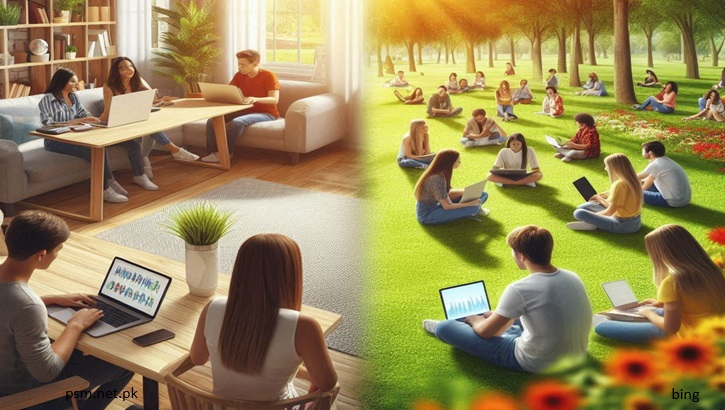
Open learning is a concept that makes learning more customer- and student-centered and a method that emphasizes access to educational options. As much as possible, learning gives the student the freedom to decide how, when, where, and what they want to study while staying within the limitations of any given education and training program. This implies that the learning process itself is more flexible in addition to making access to education more egalitarian, enabling anybody to begin the process of obtaining a certificate through higher education. One way to give flexibility is by:
- The course/subject entry and exit times,
- The mode of learning,
- The mode of attendance,
- The resources made available for learning,
- The pace of learning,
- The interaction between learners,
- The support provided for learners, and
- The methods of assessment.
ALSO READ: Evaluate the policies for teacher education in Pakistan and ways to improve it
Therefore, the phrase “flexible learning” is frequently used instead of “open learning” (Lewis, 1993), and the educational goal of “student-centered” learning is also grouped under the general term “open learning,” as proponents of this philosophy seek to empower people to take charge of their education. Their goal is for the student to become a strategic, self-reliant, and reflective expert learner (Ertmer and Newby, 1996).
In open learning, students play the role of active participants whose suggestions and opinions are taken into consideration. Students must have the freedom to voice their ideas on the options presented to them to exercise their right to choose. Any course creation must consider the motivations, goals, and preferences of the students in addition to meeting the learning objectives. Employees must be prepared to accept the chance of letting learners handle their education and work with them in such an endeavor. It would be expected that students’ reactions to flexible learning initiatives would be varied, given the dynamic and diverse nature of the student body.
When presented with new ways of teaching, students often need to develop new and unfamiliar learning techniques. Not only should this skills shortage be acknowledged, but they must be given the opportunities to develop these skills.
Note-taking and information-gathering abilities are traditionally taught to students; however, it is now required to incorporate study skills like group collaboration and presentation. It’s important to keep in mind that even while we want to help students become more self-sufficient learners, the tutor must remain a motivating and encouraging component of the student’s overall growth. The student needs instant and ongoing feedback on his or her progress since this not only gives the student a sense of accomplishment but also validates the learning technique that the student has chosen.
Open learning requires a strong sense of motivation. It demands a significant time and energy investment. The institution must provide its financial, material, and moral support for the endeavor if it hopes to encourage the person to embrace student-centered education methods and creative ways of student learning. The institution will become inferior, and workers will be sacrificed if such a course is taken. Academics still have too many teaching duties, which leaves them with little time to pursue research or teaching as scholars.
Remote Learning
Students who might not always be able to attend classes in person are taught through remote education, also known as distant learning. Distance education allows students to take lessons in the comfort of their own homes, offices, or classrooms, either live or recorded. As the price of providing high-quality education rises, educational institutions discover that their restricted funding keeps them from extending their courses, recruiting more teachers, or developing new buildings. Utilizing remote learning to optimize resources, they are pooling their efforts with those of others to create programming. Distance education is available locally, regionally, nationally, and worldwide via all available conferencing technologies.
In situations where face-to-face connection is not feasible, distance learning solutions allow students and teachers to communicate. Instead of transporting people, telecommunications systems provide information or instruction. Technology in remote places is significant and influences how people connect, what information resources are used, and the likelihood of the system being effective. Through the use of technology, students and teachers may engage and communicate when they are in different places. The learner might be at home, at the workplace, in the learning center, or in the classroom. A media studio, business, house, or classroom might be the instructor’s location.
ALSO READ: Fully Funded Scholarships at King Abdullah University of Science and Technology (KAUST) 2025-2026
Information, not people, is transported by technology. Both new information age equipment and a variety of well-known technologies are used to bridge the gap between professors and pupils. The number of channels that may be transmitted via any transmission media might be significantly increased by advances in digital compression technology, perhaps doubling or even tripling the channel capacity. Furthermore, distant learning technologies are expanding our understanding of how, where, and by whom students learn. No one technology is optimal for every application and circumstance. The ability of various technologies to meet educational demands will determine their successful deployment.
Information can be sent to the student via satellite, microwave, or fiber optic cable; television (broadcast, cable, or Instructional Television Fixed Services (ITFS); video cassette or disc; telephone (direct phone line or audio conferencing bridge); paper materials (text, study guide, or handout); computer (modem or floppy disc); and compressed video. Recent technological advancements have produced increasingly strong, adaptable, and reasonably priced systems. The foundation of information technology resources is growing at a startling rate. Since a lot has been discovered about integrating different types of technology into systems, the capacity to do so is expanding.
The majority of distant learning systems are hybrids, integrating several technologies such as computer connections, satellite, ITFS, microwave, cable, and fiber optic. Two-way computer connections, two-way audio, two-way video or graphics interactivity, and telephones (one-way video and two-way audio) are all ways to achieve interactivity. Although engagement may be delayed, it is still possible for students to contact teachers during office hours or through time spent with facilitators on-site. High student enrollment limits the quantity of interaction in the classroom. A large portion of computer network activity also occurs on a delayed basis. Interaction between audio and visuals is becoming more and more possible.
In the early days of remote learning, students in rural areas who lived far from an educational institution were the ones most frequently enrolled. Before going to the nearby institution to take a test, the student may read textbooks, send in assignments, watch a telecourse on television, and more. Although this approach is still in use, the usage of distance education has grown as technology has advanced and the cost of equipment has decreased. High upfront expenditures stopped electronically mediated learning from being widely used early on. Because distance learning may address some educational demands, it has been widely accepted.
As the concept of accountability became accepted and laws required certain courses in high school for students to be admitted to state colleges, telecommunications was examined as a way to provide student access to the required courses. Many rural school districts could not afford the special teachers to conduct required courses. Distance education met this need by providing courses in schools where teachers were not available or were too costly to provide for a few students. It also fulfilled a need for teacher training and staff development in locations where experts and resources were difficult to obtain. These systems link learner communities with each other and bring a wide array of experts and information to the classroom.
Technologies of Distance Education
Although the expansion of the Internet blurs the boundaries, distance education technologies are divided into two modes of delivery:
- Synchronous learning
- Asynchronous learning
ALSO READ: Researchers in Quantum Physics found evidence of “Negative Time”
Benefits of Distance Education
i. Distance learning can expand access to education and training for both the general populace and businesses since its flexible scheduling structure lessens the effects of the many time constraints imposed by personal responsibilities and commitments.
ii. Devolving some activities off-site alleviates institutional capacity constraints arising from the traditional demand on institutional buildings and infrastructure.
iii. Furthermore, there is the potential for increased access to more experts in the field and to other students from diverse geographical, social, cultural, economic, and experiential backgrounds.
iv. As the population at large becomes more involved in lifelong learning beyond the normal schooling age, institutions can benefit financially, and adult learning business courses may be particularly lucrative.
v. Distance education programs can act as a catalyst for institutional innovation and are at least as effective as face-to-face learning programs, especially if the instructor is knowledgeable and skilled.
vi. The improvement being made in distance education is growing in tandem with the constant technological advancements. Present-day online communication allows students to associate with accredited schools and programs throughout the world that are out of reach for in-person learning.
vii. By having the opportunity to be involved in global institutions via distance education, a diverse array of thought is presented to students through communication with their classmates.
viii. Learners become aware of the variations in interpretation and construction of meaning among a range of people
ix. Distance education has been a more cost-effective form of learning, and can sometimes save students a significant amount of money as opposed to traditional education.
x. Students can review their lessons more than once according to their needs. Students can then manipulate the coursework to fit their learning by focusing more on their weaker topics while breezing through concepts that they already have or can easily grasp.
xi. Distance learning may enable students who are unable to attend a traditional school setting, due to disability or illness such as decreased mobility and immune system suppression, to get a good education.
Read our blog: PakSci Mission