
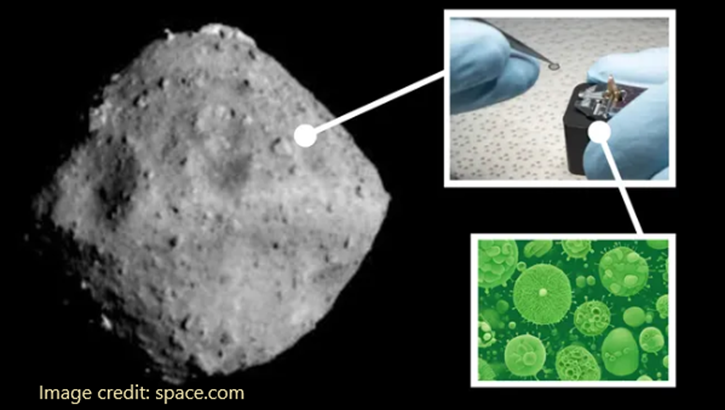
Researchers have found that after being transported to Earth, a sample of the asteroid Ryugu was infested with life forms from Earth. The study demonstrates the efficacy of terrestrial microorganisms in colonizing extraterrestrial materials.
The samples under investigation were from the spacecraft Hayabusa2, operated by the Japan Aerospace Exploration Agency (JAXA), which launched in December 2014 and made contact with Ryugu in June 2018. After monitoring the asteroid for a year, Haybusa2 dove to the surface and collected a sample. The asteroid is about 3,000 feet (900 meters) in diameter.
On December 6, 2020, the Ryugu sample was sent back to Earth, but Haybusa2 went on to investigate further asteroids. The sample was divided up and sent to several scientific teams, including the one responsible for this remarkable finding.
“We found microorganisms in a sample returned from an asteroid.”.
After first appearing on the rock, they gradually dispersed until eventually going extinct, Imperial College London team leader Matthew Genge told Space.com. “The shift in the quantity of microorganisms verified that these were live bacteria. However, it also suggested that they were terrestrial in origin and had only recently colonized the specimen before our studies.
The scientists identified the findings as filamentous microorganisms since it appeared as rods and threads of organic materials. Although the team is unsure of the precise sort of microbes they were, Genge has a fair sense of what they may be.
The researcher stated, “It is impossible to identify their exact type without studying their DNA.” “However, they were most likely bacteria such as Bacillus since these are very common filamentous microorganisms, particularly in soil and rocks.”
It demonstrates that microbes may easily metabolize and survive on materials from other planets. Homegrown organic matter is plentiful on Earth, but extra-martian organic matter may sustain an ecosystem on worlds like Mars.
We can never fully rule out terrestrial contamination since terrestrial microorganisms are the finest colonizers on Earth,” the researcher added. “As long as you know where it comes from, contamination is usually not an issue. The issue arises when scientists try to assert that a specimen’s “pristine” state proves that its traits are alien.
The research was published in the journal Meteoritics & Planetary Science.
Read the full article here.