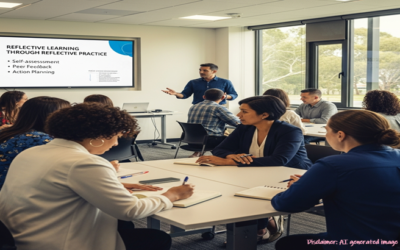

Cooperative learning
Small groups are used in the classroom during cooperative learning to help students collaborate to maximize both their own and each other’s learning. These are additional guidelines and methods to help students collaborate more successfully. Getting two or more students to collaborate to learn is known as cooperative learning, according to UNESCO in 2003. To master information that was previously prepared by an instructor or to generate knowledge on substantive concerns, students frequently work in small groups with members of varying skill levels, utilizing a range of learning strategies. Every team member must absorb the information imparted to them and support the learning of colleagues.
Panitz (1996) employs the following terminology to distinguish between cooperation and collaboration: “Collaboration is a philosophy of interaction and personal lifestyle whereas cooperation is a structure of interaction designed to facilitate the accomplishment of an end product or goal.”
According to Gerlach (1994), cooperative learning is defined as: “Cooperative learning is based on the idea that learning is a naturally social act in which the participants talk among themselves. It is through the talk that learning occurs.”
Although cooperative learning is defined by Gokhale (1995) as: “An instruction method in which students work in groups toward a common academic goal.”
Since students spend most of their time talking to one another in real life, speaking in groups feels more natural. They often have a more formal setting and have taken time to prepare their speech if they are speaking in front of a sizable crowd. Students gain interpersonal skills and learn how to work together in small groups. Students learn how to work with a wider range of people when they collaborate with peers who are not their friends. This promotes the development of tolerance, respect for others, and harmony. Anxiety will undoubtedly be forgotten if pupils collaborate joyfully.
Read: The effectiveness of the guided discussion method in teaching
Cooperative learning creates a special learning environment that is open for any kind of beneficial information, exchange of ideas, trust building, sharing of ideas, and ongoing cooperative process. Learners work together, participating in various groups and teams. That is why the definition “learning community” is so often mixed with such definitions as “learning teams”, “partnerships”, or “mentorships”.
Strategies of Cooperative Learning
The planning, interpreting, and evaluating might be done via cooperative learning techniques. Instructors ought to push their pupils to take part in insightful conversations. Various cooperation tactics comprised:
Jigsaw:
Students are divided into groups of five. The group is given a topic or assignment by the academic person. Every student receives a set of materials to study and instruct the other students in his group. A group of students who are working on the same topic come together to talk about the key ideas and how to present them to the class as a whole. Following their practice sessions in these “expert” groups, the original groups reunite and impart knowledge to one another. There are evaluations and tests after.
Think-Pair-Share:
This is a short and easy method where the teacher creates questions that require analysis, preferably one that demands it, allows the students a few minutes to consider their answers, and then asks them to discuss their answers with a partner. It is also possible to write during this “think-time.” After that, the students exchange their answers with a companion. They get the chance to gather and arrange their ideas through this exercise. Students are encouraged to compare and contrast their understanding with that of others through the “pair” and “share” components. They are also encouraged to practice their responses in a low-risk setting before presenting them to the class as a whole. The answers can then be discussed in a follow-up session with the full class, a bigger group, or a learning team consisting of four people. All students have an opportunity to learn by reflection and by verbalization.
Three-Step Interview:
This framework is frequently used as a way to break the ice or foster teamwork. It may also be used to communicate information like theories or opinions about a movie or article. In it, each team member selects a partner from among themselves. Students divide into pairs, or dyads, for the first stage, and one student interviews the other. Then, the students take turns playing different parts. In the third stage, the dyad forms a link with another dyad. Following that, this four-person learning team talks over the data or revelations from the first round of paired interviews.
Numbered Heads Together:
Learning teams, which are often made up of four people, count off 1,2,3, or 4. Then the instructor asks a question that calls for higher-order thinking abilities even if the answer is usually true. Students debate the issue and ensure that everyone in the group is aware of the consensus response. The team members who first assigned that number during the count-off answer as the group spokespersons when the instructor calls that number. All team members have a stake in knowing the right answer since nobody can predict the teacher’s phone number. Once more, verbalization aids pupils, and peer coaching supports both high and poor performers. Class time is usually better spent because less time is wasted on inappropriate responses and because all students become actively involved with the material.
Round Robin:
Students mostly use it as a brainstorming approach, coming up with ideas but without explaining, evaluating, or challenging them. Members of the group take turns answering questions with words, phrases, or brief comments. After every student has had a chance to speak, the replies are arranged in chronological order going from one to the next. Because it discourages remarks that disrupt or impede the flow of thoughts, this strategy facilitates the generation of many ideas from all of the students who participate. Using the concepts, one might create a strong paragraph about a certain subject.
Three-minute review:
The teacher can pause at any point during a lesson or discussion on the different styles of writing letters, reports, etc., and offer the team members three minutes to summarise the material, ask clarifying questions, or provide more information.
Numbered Heads:
A four-person squad is formed. One, two, three, and four are assigned to each member. The collective is questioned. To enable everyone to respond orally, groups collaborate to provide answers to the questions. When the teacher says the number three, the third person in each group is requested to respond. You might use this for comprehension drills.
Buzz Groups:
Teams of four to six students that come together rapidly and spontaneously are called buzz groups. They talk about the assigned themes or other topics that have been given to them. They exchange ideas in an informal discussion. Buzz Groups function as an icebreaker for class discussions as a whole. They work well when it comes to quickly producing ideas and information. You might use this method to compose articles about current events.
Talking Chips:
Students engage in group discussions while playing talking chips, giving away a token each time they speak. By limiting the number of times each group member is permitted to participate, this strategy guarantees fair participation. With the use of this strategy, quiet students are encouraged to engage and find solutions to communication or procedural issues, such as controlling or conflicting group members.
Critical Debate:
This practice might be utilized while composing argumentative essays. Students choose a position on a subject that differs from their own in this individual assignment. Teams are formed, and they debate, present, and refute the other team’s position on the matter. It exposes the students to a targeted, in-depth, multiple-perspective investigation of topics. It can help students see the variety of viewpoints present in complicated problems, go beyond simplistic dualistic thinking, and get a deeper knowledge of a problem. This method is appropriate for students in higher education.
Write Around:
Teachers might provide a sentence beginning (e.g., If there were no Plants on the World) for creative writing or summarising assignments. Each team member must complete the line, “A man met an alien on the seashore.” After that, they read the paper they are given, pass it to the right, and add sentences to one. Four tales or summaries appear after a few rounds. Give students enough time so they may revise and/or add a conclusion before sharing their work with the class.
Praise-Question-Polish:
Using this method, group members alternately read aloud from their papers while the other group members keep copying along. The responders are first requested to answer the written work by indicating what they found appealing (Praise), and what they did not understand (Question), and then providing concrete recommendations for how the writing may be improved (Polish). Through critical analysis of one another’s work, the students would be able to enhance their writing.
Read our blog: PakSci Mission