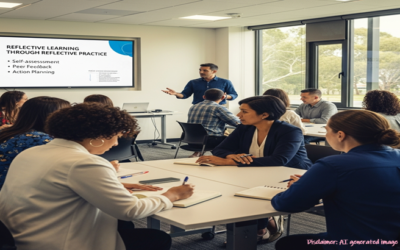

Preparing for the audio-visual activities
The key to preparing effective audiovisual aids is to remember that they are only aids. Their function is to provide the points you expressed orally with a visual component. They can only reaffirm what you already know; they cannot make those arguments for you. These easy rules should be followed while making audiovisual aid plans:
1. We can use audiovisual aids to summarize or show the sequence of content.
2. We can use them to visually interpret statistics by preparing charts and graphs that illustrate what you will say.
3. We can use them to illustrate and reinforce your support statements.
4. We can use them to add visual clarity to our concepts and ideas.
5. We can use them to focus the attention of the target group on key points.
6. We should not project copies of printed or written text. Instead, summarize the information and show only the key points on the visual aids. If the group must read every word, use handouts for reading, either before or after your presentation.
7. Do not put yourself in the role of aiding your visuals: A presentation is primarily an oral form of communication. If your only function is to read the information on your overheads or slides, the target group will become easily bored.
8. Do not use copies of your transparencies as handouts. They reinforce what you are saying– they don’t say it for you. If you want your target group to remember what you meant, you’ll need to provide written text in addition to any key point summaries or charts that you need for your transparencies.
9. Do not use charts, graphs, or tables that contain more information than you want to provide.
Read: The need and importance of instructional resources in education
It is established that the projector is a useful device. It provides us with larger, crisper, more vibrant, and more defined visuals. More astonishingly, our eyes are unaffected by even the brightest pictures when we are in a dimly lit or dark place. Isn’t that incredible? These electronic gadgets are so tolerant that they may be seen in homes, workplaces, and even classrooms. Indeed, classrooms. Nowadays, every classroom at those prestigious schools is equipped with a projector. Projectors are used to deliver the lectures, which improves student concentration and comprehension. Even though projectors improve student learning, the majority of school administrators still oppose placing them in every classroom. It is a result of the few significant drawbacks associated with projector use in schools.
Problems using the projector in the classroom
- Cannot be used for a long time.
- Writing with some types of writing pens gets blotted out on plastic.
- Transparencies create a storage problem.
- Projectors provide an adverse environment.
- The cost of installing projectors in every classroom would be high.
- The projectors would significantly raise the cost of power.
- Projector use would create an environment where pupils are more likely to engage in harmful behaviors.
- Most of the room would be occupied by the projector.
- Much noise would be produced.
Read our blog: PakSci Mission